There's a lot more technology in advertising than when I graduated from portfolio school with a book full of double-page print ads. And the great thing about technology is it lets so many of us become makers. But sometimes we get so excited about what we can do, we lose sight of what we're doing.

Showing posts with label technology. Show all posts
Showing posts with label technology. Show all posts
Say My Name, Bitch

The etymology of branding starts with cattle. In order to tell one rancher's cows from the thousands of other virtually identical cows on the range, ranchers would brand them with a unique mark. Theoretically, the branding we speak of when we gather in agency and client conference rooms across the globe is a little more sophisticated. Branding shouldn't be synonymous with "labeling." It should be more like "brand character development." I should be learning something about your brand or product. You should be giving me something, adding something to my life, creating a positive association with your brand. Something to help me like it.
Yet, in any creative presentation, we hear: "I'd like to see more branding." "More branding upfront." "More brand registration." In other words, say our name, show our logo, and then say our name some more. Because, as we all know, someone repeating their name over and over and over makes us like them. "Hi, I'm Billy. It's my name. Billy. Billy is here!"
A lot of brands put their ads through quantitative testing. Companies like Ipsos ASI have perfected the art of making billions of dollars by dumbing down creative work, mostly by insisting that they need "more branding." They do this because they believe in an inherent link between engagement, recall and likability. In other words, people remember what they like. Which seems true. But it also leads to the foolish belief that I can make you like my brand simply by repeating my name enough. Being memorable is not the same as being likable. If I burn my name into your arm with a hot metal poker, I can guarantee you'll remember me. Does that mean you'll like me?
In the latest example of this confused philosophy, a company called Solve Media has developed a system by which CAPTCHAs are branded. You know CAPTCHAs. They're those squiggly words you have to decipher when you buy tickets online, etc. They basically verify that you're a human.
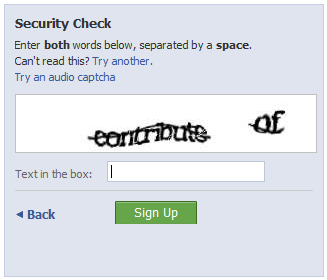
I think most of us would agree that CAPTCHAs are fairly annoying. A necessary evil at best (however, as an aside, I do find the use of ReCAPTCHAs to be a cool, innovative solution to two problems at once). So the brainstorm of the people at Solve Media is to create branded CAPTCHAs. Instead of typing in "contribute of," you might be asked to type in "The Ultimate Driving Machine" or "Just Do It" (though I doubt either BMW or Nike will engage in this type of "branding.")
Here's a little video championing this innovation:
Solve Media from Solve Media on Vimeo.
The problem here is twofold:
1) You're associating a brand with something annoying and intrusive. What are you giving me here? You're standing between me and something I want with your stupid slogan. Rather than walking away with a positive impression, I'm irritated, and your brand is the source of my irritation.
2) This is amoeba-level marketing. Just because I see your slogan doesn't mean I like your brand. "Hi. It's me again. Billy. Remember me? I told you my name earlier. It's Billy! Billy is here!"
Come on, folks. We can do better than cattle branding.
An Interview with Lionel Carreon

This is a great quote from an insightful interview with Lionel Carreon, senior creative recruiter at AKQA (full interview here):
What do you see over and over in portfolios that makes you cringe?
Thankfully, there isn’t much that is consistently cringe-worthy, apart from the occasional misguided idea. What I have noticed is that digital components have become as much a checklist item just like a TV spot or a print ad. They are often included in student campaigns for the sake of having them, often without any relevancy to the overall brand message and lacking any true innovation or strokes of genius. Two years ago it was an iPhone app, last year it was Twitter, this year Foursquare.
Very relevant to what I often see in my portfolio development class as well. Especially when it comes to that final quarter, students are often looking to check boxes. If it's not a great concept, it doesn't belong in your book, period.
Last night in class, someone set up a concept with "This is a Facebook idea." Alarm bells went off right then. If you're not setting up the idea with an insight about the brand and/or consumer, you should ask yourself if there is an idea. I heard the same theme consistently from speakers at Cannes this year: TECHNOLOGY IS NOT AN IDEA.
I completely understand the need and want to show that you are up on the latest technology, but without a relevant idea, it's nothing. Ironically, agencies often do the exact same thing when they pitch new business--at the last second, they'll say, "Shit! What's our Twitter idea? We need a Twitter idea!" No, you don't. You need a good idea, and maybe Twitter will be the best way to bring it to life.
Technology and Storytelling

The tools have changed, the storytelling hasn’t. But technology has had a tremendous impact on the storytelling process…If you don’t understand technology and the impact on communications and design and creativity, I really think you’re going to get left on the sidelines going forward.
- Bob Greenberg
Noam Murro on Storytelling

Every time I thought I’m going out to do something great, it turned out to be shit. And vice versa. I think that it starts with these guys (gesturing to the creatives), you know? If on the page it’s good, most likely it’ll be OK when you shoot it. You cannot take a piece of crap and make it great; throw money at it, put a great director on it. It really is as good as the page is. There is so much talk about evolution and I feel like I’m in business at a grocery store actually versus everything else that has been said here. Essentially I don’t really care what it’s going to be played on. At the end of the day it all culminates to this human experience – “Can I relate to whatever has been presented to me or not?” And I think that there’s so much talk about digital – digital schmigital. Amazon came out with the Kindle, right? But it’s still the same Anna Karenina on it. And it’s still pretty damn good.
-Noam Murro
Subscribe to:
Posts (Atom)